
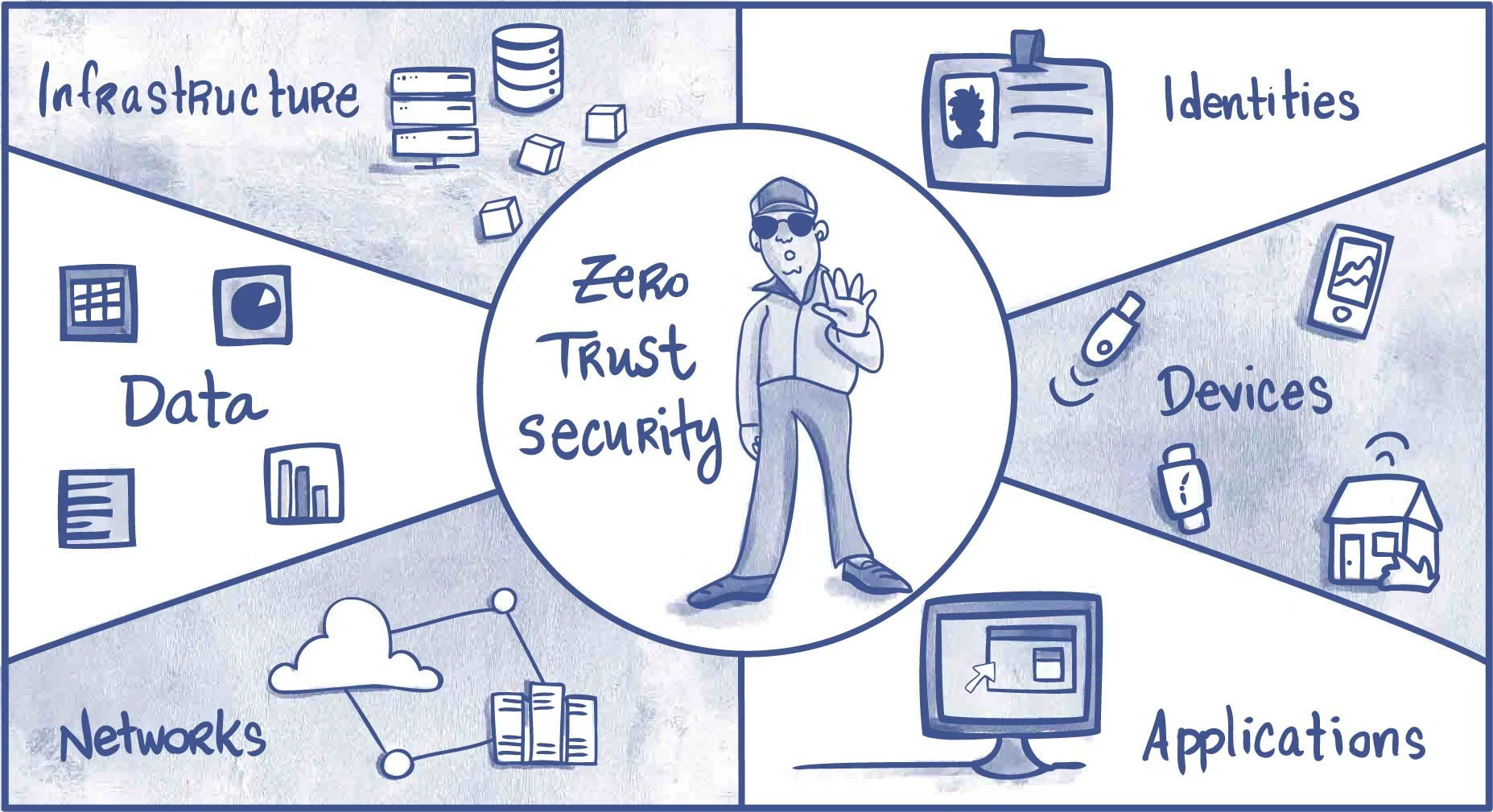
Traditional cloud security operated on a perimeter-based model—often called the “castle-and-moat” approach. Once a user or application gained access through a Virtual Private Network (VPN) or enterprise gateway, they were implicitly trusted inside the network.
In modern multi-cloud ecosystems, the perimeter no longer exists. Distributed workforces, third-party vendor integrations, microservices, and mobile endpoints make perimeter-based trust obsolete. Zero Trust Architecture (ZTA) shifts security from network-location-based implicit trust to continuous, context-aware explicit verification for every access request.
Core Principles of Zero Trust in the Cloud
Zero Trust is governed by three foundational tenets defined by NIST (Special Publication 800-207):
+--------------------------------------------------------------------------+
|                     CORE TENETS OF ZERO TRUST                            |
+--------------------------------------------------------------------------+
|  1. EXPLICIT VERIFICATION --> Always authenticate based on context       |
|  2. LEAST PRIVILEGE       --> Grant minimal permissions (JIT/JEA)        |
|  3. ASSUME BREACH         --> Minimize blast radius via micro-segmentation |
+--------------------------------------------------------------------------+
-
Always Verify (Explicit Trust): Never rely on network positioning. Continuously validate identity, device health, location, workload posture, and risk signals before granting access to any cloud asset.
-
Least Privilege Access: Restrict user and service account permissions to the absolute minimum required to perform a task. Utilize Just-In-Time (JIT) and Just-Enough-Access (JEA) controls to avoid permanent standing privileges.
-
Assume Breach: Design systems under the assumption that malicious actors are already inside the environment. Minimize lateral movement by segmenting workloads, encrypting end-to-end data flows, and inspecting all internal traffic.
The 6 Pillars of Zero Trust Cloud Implementation
A comprehensive cloud Zero Trust strategy requires applying security controls across six integrated domains:
                     +---------------------------+
                     | Identity (New Perimeter)  |
                     +---------------------------+
                                   |
    +-----------------+------------+------------+-----------------+
    |                 |                         |                 |
    v                 v                         v                 v
[ Devices ]    [ Workloads/Apps ]          [ Network ]        [ Data ]
1. Identity as the New Perimeter
Identity and Access Management (IAM) replaces physical network perimeters.
-
Enforce phishing-resistant Multi-Factor Authentication (MFA) across all users.
-
Leverage continuous session adaptive controls that evaluate dynamic risk scores during active sessions rather than at initial login alone.
2. Device Posture Verification
A validated identity on a compromised or unpatched device remains an exploitation vector.
-
Inspect operating system patch status, Endpoint Detection and Response (EDR) agent health, and disk encryption state before granting access to cloud APIs or resources.
3. Network Micro-Segmentation
Traditional Cloud VPCs rely on wide internal subnets where workloads can communicate freely.
-
Implement granular micro-segmentation using software-defined firewalls and service meshes (e.g., Istio, Envoy) to isolate individual application tiers.
-
Restrict “east-west” (internal server-to-server) traffic so a compromised front-end container cannot access back-end database subnets.
4. Application & Workload Security
Microservices, APIs, and serverless functions must authenticate directly with each other.
-
Use mutual TLS (mTLS) to encrypt and authenticate all inter-service communications within Kubernetes or container clusters.
-
Secure API gateways with Web Application Firewalls (WAF) to inspect data payloads for SQL injections or unauthorized token usage.
5. Data-Level Controls
-
Classify data automatically upon creation and apply hardware-backed encryption (AES-256) at rest and in transit.
-
Enforce Data Loss Prevention (DLP) policies to prevent sensitive datasets from leaving approved cloud tenants.
6. Continuous Visibility & Analytics
-
Feed cloud audit logs (AWS CloudTrail, Azure Activity Log, GCP Cloud Audit) and telemetry into a central SIEM and SOAR platform.
-
Use AI-driven anomaly detection to instantly flag abnormal administrative behavior or automated access attempts.
Operational Workflow: How Zero Trust Evaluates a Request

+--------------------------------------------------------------------------+
|                    ZERO TRUST REQUEST ACCESS FLOW                        |
+--------------------------------------------------------------------------+
| 1. Request Initiated  --> User/Workload requests access to Cloud DB     |
| 2. Context Evaluation --> Checks Identity + Device Health + Location     |
| 3. Policy Decision    --> Dynamic Engine calculates real-time Risk Score  |
| 4. Grant / Deny       --> Temporary, scoped access token issued          |
+--------------------------------------------------------------------------+
-
Request: A user attempts to connect to a cloud database from a remote laptop.
-
Evaluation: The Policy Engine evaluates context: Is the identity verified via MFA? Is the EDR agent active? Is the access location typical?
-
Decision: If the risk score passes, the Policy Engine grants a short-lived access token specifically for that single database endpoint—blocking access to all other network resources.
-
Continuous Re-evaluation: If the user shifts networks mid-session or device compliance fails, access is revoked automatically.
Zero Trust Adoption vs. Traditional VPNs
| Security Feature | Traditional VPN Model | Cloud Zero Trust (ZTNA) |
| Trust Boundary | Network-based (Once inside, trusted by default) | Request/Resource-based (Verify every interaction) |
| Lateral Movement | High risk; flat network access | Minimal; micro-segmentation blocks sideways movement |
| Access Scope | Broad access to entire subnets | Granular access to specific applications only |
| User Experience | Frequent disconnects, high latency routing | Direct, seamless cloud connection via ZTNA edge nodes |