

Kubernetes (often abbreviated as K8s) is an open-source container orchestration platform originally created by Google and now maintained by the Cloud Native Computing Foundation (CNCF). It automates the deployment, scaling, management, and networking of containerized applications across clusters of physical or virtual machines.
As organizations transition from monolithic applications running on traditional virtual machines to microservices running in containers, managing dozens or thousands of containers manually becomes impossible. Kubernetes acts as the “operating system” for the cloud, abstracting away the underlying infrastructure so engineering teams can deploy software reliably at scale.
1. Core Architecture of Kubernetes
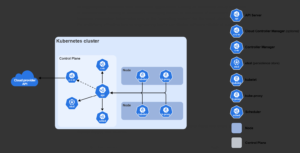
A Kubernetes cluster is divided into two primary zones: the Control Plane (the brain) and the Worker Nodes (the muscle).
+--------------------------------------------------------------------------+
|                       KUBERNETES CLUSTER TOPOLOGY                        |
+--------------------------------------------------------------------------+
|  CONTROL PLANE (Brain)                                                    |
|  * kube-apiserver  --> Primary REST entrypoint for all cluster management|
|  * etcd            --> Key-value store holding entire cluster state      |
|  * kube-scheduler  --> Assigns newly created Pods to optimal Nodes       |
|  * controller-mgr  --> Enforces desired state (e.g., node recovery)      |
+--------------------------------------------------------------------------+
                                    |
                                    v
+--------------------------------------------------------------------------+
|  WORKER NODES (Muscle)                                                    |
|  * kubelet         --> Agent ensuring containers run according to spec   |
|  * kube-proxy       --> Handles network routing and load balancing      |
|  * Container Engine--> Runtime (e.g., containerd) executing containers   |
+--------------------------------------------------------------------------+
Essential Abstractions
-
Pod: The smallest deployable unit in Kubernetes. A Pod holds one or more tightly coupled containers sharing the same network IP and storage volumes.
-
Node: A single worker machine (virtual machine or physical bare-metal server) running containers inside the cluster.
-
Deployment: A declarative specification defining how many replicas of a Pod should run, along with update and rollback strategies.
-
Service: An abstraction defining logical sets of Pods and a policy to access them (providing persistent IP addresses and load balancing).
2. Why Kubernetes is Essential for Modern Cloud Management
Managing modern cloud infrastructure involves maintaining high availability, optimizing compute spend, and enabling continuous integration and deployment (CI/CD). Kubernetes has become the industry standard for cloud management due to several operational advantages:
                  +--------------------------------------+
                  |    KEY OPERATIONAL VALUE PROPOSERS   |
                  +--------------------------------------+
                                     |
       +-----------------------------+-----------------------------+
       |                                                           |
       v                                                           v
[ AUTOMATED RESILIENCE ]                                    [ MULTI-CLOUD PORTABILITY ]
* Self-healing failed containers                            * Runs identically on AWS, Azure, GCP
* Zero-downtime rolling updates                             * Eliminates vendor lock-in risk
* Declarative state enforcement                             * Standardizes developer workflows
1. Self-Healing & High Availability
If a container crashes, Kubernetes automatically restarts it. If a worker node dies, Kubernetes reschedules all affected Pods onto healthy nodes elsewhere in the cluster. It constantly monitors health checks and routes network traffic away from unresponsive instances.
2. Horizontal Autoscaling
Kubernetes scales applications dynamically based on real-time resource utilization:
-
Horizontal Pod Autoscaler (HPA): Adds or removes application Pods as CPU, memory, or custom metric thresholds spike or drop.
-
Cluster Autoscaler / Karpenter: Provisions new cloud compute instances (VMs) when existing nodes run out of capacity, and terminates idle nodes to cut costs.
3. Declarative Configuration & Infrastructure as Code (IaC)
Instead of executing imperative commands to launch infrastructure, operators write declarative YAML or JSON files describing the desired state of the application. Kubernetes continuously works behind the scenes to match the actual state to this desired state.
4. Zero-Downtime Deployments & Automated Rollbacks
Kubernetes supports automated rolling updates, allowing teams to push new application versions with zero downtime. If a bug is detected during rollout, Kubernetes can automatically halt the process and roll back to the previous stable state.
5. Multi-Cloud Portability & Vendor Decoupling
Because Kubernetes provides a unified abstraction layer over compute, networking, and storage, applications run identically whether hosted on AWS (EKS), Microsoft Azure (AKS), Google Cloud (GKE), or on-premises bare metal. This eliminates cloud provider lock-in and simplifies hybrid and multi-cloud strategies.
3. Comparison: Manual Cloud Management vs. Kubernetes
| Feature / Task | Traditional / Manual Cloud Management | Kubernetes-Managed Cloud |
| App Deployment | SSH into individual VMs or run manual scripts | Apply declarative YAML manifests (kubectl apply) |
| Failure Recovery | Manual intervention or basic auto-scaling groups | Instant, automated self-healing and pod rescheduling |
| Resource Efficiency | Low (VMs often sit idle at 10–20% utilization) | High (Dynamic bin-packing achieves 60–80% utilization) |
| Scaling Speed | Slow (Minutes to boot up full VM operating systems) | Fast (Seconds to spin up lightweight container pods) |
| Multi-Cloud Consistency | Managed using vendor-specific APIs (AWS CLI, Azure CLI) | Standardized API across all clouds and data centers |
Summary
Kubernetes is essential for cloud management because it bridges the gap between software development and infrastructure operations. By automating container scheduling, self-healing, scaling, and load balancing, it allows engineering organizations to run complex, distributed microservices reliably while maximizing cloud resource utilization and minimizing operational overhead.