
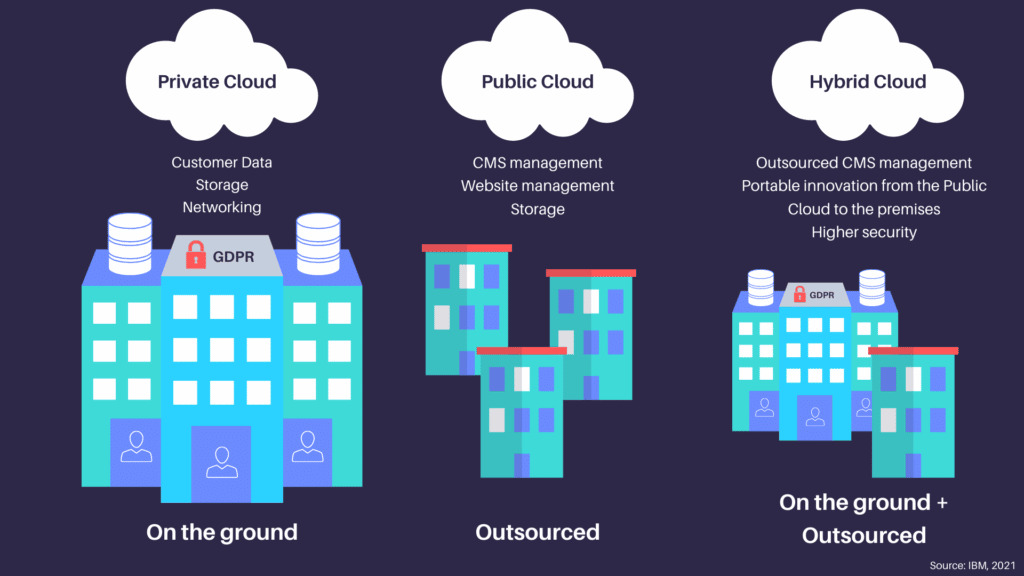
Choosing a cloud deployment model is one of the most critical decisions an organization makes during its digital transformation. Rather than asking whether to move to the cloud, modern IT leaders ask where specific workloads belong.
The three main deployment models—Public Cloud, Private Cloud, and Hybrid Cloud—each balance scale, control, security, and cost differently. This guide compares these models to help you identify the best fit for your business goals.
Understanding the Three Cloud Deployment Models
+-----------------------------------------------------------------------------+
|                            CLOUD DEPLOYMENT MODELS                          |
+-----------------------------------------------------------------------------+
|  PUBLIC CLOUD     | Multi-Tenant Infrastructure Managed by Vendor (AWS, Azure)|
|  PRIVATE CLOUD    | Single-Tenant Dedicated Hardware (On-Premises / Hosted)    |
|  HYBRID CLOUD     | Integrated Infrastructure Combining Public + Private        |
+-----------------------------------------------------------------------------+
1. Public Cloud: Speed, Scale, and Innovation
What is It?
In a public cloud model, infrastructure (servers, storage, networking) is owned and operated by a third-party vendor (e.g., Amazon Web Services, Microsoft Azure, Google Cloud Platform). Computing resources are shared across multiple organizations (tenants), but each customer’s data remains logically isolated.
Key Benefits
-
Infinite Scalability: Instantly scale computing capacity up or down to handle traffic spikes.
-
Zero Capital Expenditure: Avoid upfront hardware costs; pay only for consumed resources.
-
Access to Cutting-Edge Tools: Direct access to advanced managed services like generative AI models, serverless frameworks, and big data pipelines.
Limitations
-
Less Granular Control: You cannot customize underlying hardware or low-level security architectures.
-
Unpredictable Costs: Unmonitored scaling or unmanaged egress fees can lead to budget overruns.
2. Private Cloud: Total Control and Compliance
What is It?
A private cloud environment is dedicated exclusively to a single organization. It can be hosted physically in an on-premises company data center or managed off-site by a third-party provider in a dedicated environment.
Key Benefits
-
Enhanced Data Security: Ideal for sensitive data subject to strict regulations (e.g., HIPAA, PCI-DSS, GDPR).
-
Customizable Architecture: Configure hardware, network routing, and security policies to precise internal operational specifications.
-
Predictable Performance: Eliminates the “noisy neighbor” effect, ensuring consistent processing power for core applications.
Limitations
-
High Capital Expenditures: Involves substantial upfront investment in physical hardware, facility cooling, and maintenance.
-
Slower Elasticity: Scaling capacity requires manual hardware procurement and provisioning cycles.
3. Hybrid Cloud: The Strategic Balance
What is It?
A hybrid cloud seamlessly integrates public and private cloud environments. Orchestration tools allow data and applications to move fluidly between systems based on workload requirements, cost, or security policies.
Key Benefits
-
Workload Placement Flexibility: Keep sensitive customer databases in a secure private environment while hosting front-end web apps in the public cloud.
-
Cloud Bursting: Run everyday operations on private infrastructure, then automatically overflow extra capacity into the public cloud during temporary usage spikes.
-
Gradual Modernization: Migrate legacy workloads to the cloud incrementally without disrupting core business systems.
Limitations
-
Operational Complexity: Managing unified networking, security, and access controls across multiple environments requires experienced technical teams.
Model Comparison at a Glance
| Factor | Public Cloud | Private Cloud | Hybrid Cloud |
| Primary Audience | Startups, SaaS apps, web platforms | Highly regulated industries (Finance, Healthcare) | Mid-market & Enterprises balancing scale + compliance |
| Cost Structure | Operational Expenditure (OpEx) | Capital Expenditure (CapEx) + OpEx | Balanced OpEx and CapEx |
| Scalability | Near-instant, virtually unlimited | Limited by physical hardware budget | High; public tier handles growth spikes |
| Security Control | Shared Responsibility Model | Full control over physical & digital assets | High control for private, flexible for public |
Which Cloud Model Fits Your Business?
                    +---------------------------------------+
                    | Evaluate Primary Business Priority    |
                    +---------------------------------------+
                                        |
       +--------------------------------+--------------------------------+
       |                                |                                |
       v                                v                                v
[ Speed & Scale ]             [ Compliance & Security ]           [ Best of Both ]
       |                                |                                |
       v                                v                                v
Public Cloud                      Private Cloud                     Hybrid Cloud
Choose Public Cloud if:
-
You are building a digital-native startup, web application, or SaaS platform needing immediate scale.
-
Your workload demands fluctuate dramatically based on seasonal trends or marketing campaigns.
-
You want to focus engineering efforts on product development rather than data center maintenance.
Choose Private Cloud if:
-
You operate in heavily regulated sectors (defense, banking, healthcare) with strict data sovereignty mandates.
-
You manage predictable, steady-state enterprise systems that run 24/7/365 where owned hardware offers better long-term unit economics.
-
You require direct physical control over servers and proprietary network configurations.
Choose Hybrid Cloud if:
-
You have existing legacy on-premises investments that cannot easily move to the public cloud right away.
-
You need to keep confidential internal databases private while utilizing public cloud AI or analytics engines for big data processing.
-
You want a resilient disaster recovery strategy with real-time replication across distinct environments.