
Managing a hybrid cloud environment often presents a fundamental dilemma: How do you maintain centralized control and consistent operations without compromising on the physical proximity required for low-latency or localized processing?
Azure Arc and AWS Outposts solve this challenge, but through radically opposite architectural philosophies.
-
Azure Arc is a software-driven control plane that projects external infrastructure (on-premises servers, Kubernetes clusters, multicloud resources) into Azure.
-
AWS Outposts is a hardware-as-a-service infrastructure extension that brings physical AWS racks, servers, and proprietary AWS Nitro hardware into your local data center.
Architectural Mindset: Software Plane vs. Hardware Extension
AZURE ARC: Control-Plane Centric (Bring Your Own Hardware)
┌─────────────────────────────────────────────────────────┐
│                    Azure Portal / ARM                   │
└───────────────────────────┬─────────────────────────────┘
                            │ (Agent / API Projection)
   ┌────────────────────────┼────────────────────────┐
   ▼                        ▼                        ▼
On-Premises VMware    AWS/GCP VMs         Kubernetes Clusters
[BYO Hardware]       [Other Cloud]       [Edge Devices]


AWS OUTPOSTS: Infrastructure-Centric (AWS Hardware On-Premises)
┌─────────────────────────────────────────────────────────┐
│                      AWS Region                         │
└───────────────────────────┬─────────────────────────────┘
                            │ (Dedicated Service Link)
                            ▼
           ┌──────────────────────────────────┐
           │     AWS Outposts Physical Rack    │
           │  (Nitro Enclaves, AWS Hardware)  │
           └──────────────────────────────────┘
                 [Inside Your Data Center]
Direct Feature Comparison
| Architectural Dimension | Azure Arc | AWS Outposts |
| Primary Philosophy | Bring Azure management to your existing hardware. | Bring physical AWS cloud infrastructure into your data center. |
| Hardware Ownership | BYOH (Bring Your Own Hardware)—Dell, HPE, existing VMware/SAN. | Fully fully-managed AWS proprietary hardware (1U/2U servers or 42U racks). |
| Control Plane Location | Centralized in the public Azure Region. | Management control runs via AWS Region via a secure Service Link. |
| Disconnected Capabilities | High. Agents cache state and can run autonomously without Azure connectivity. | Limited. Outposts can cache logs/metrics temporarily, but requires the Service Link for management and API control. |
| Data Residency | Data remains entirely on your underlying storage system. | Data remains on the physical Outposts storage array on-site. |
| Deployment Lead Time | Minutes to Hours: Software agents installed on existing OS/K8s environments. | Weeks to Months: Involves physical site assessment, rack delivery, power/cooling setup, and AWS installation. |
| Pricing Model | Pay-as-you-go per service/agent (free core governance features). | 3-Year commit subscription for physical hardware capacity. |
Deep Dive: Azure Arc Implementation Strategy
Azure Arc functions by installing the Connected Machine Agent on servers or linking Kubernetes clusters via the Azure Arc agent. This projects those external assets into the Azure Resource Manager (ARM) as native Azure resources.
Key Management Capabilities
-
Unified Governance & Policy: Apply Azure Policy and RBAC consistently across servers located in on-prem data centers, AWS, GCP, or edge locations.
-
Unified Patch Management: Automate OS-level updates across all hybrid Linux and Windows machines using Azure Update Manager.
-
Run Azure Data Services Anywhere: Run managed SQL Managed Instances or PostgreSQL Hyperscale on top of any Kubernetes cluster on-premises using Arc-enabled data services.
Ideal Use Cases
-
Heterogeneous IT Infrastructure: You already own extensive hardware, SAN arrays, or VMware environments that you cannot displace.
-
Multi-Cloud Governance: You need a single pane of glass to audit security (via Defender for Cloud) across AWS, Azure, and on-premises data centers.
-
Application Modernization: You want to run standardized GitOps deployments across diverse Kubernetes environments (EKS, GKE, Rancher, OpenShift).
Deep Dive: AWS Outposts Implementation Strategy
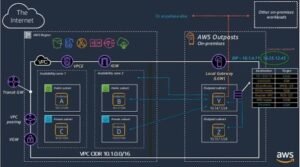
AWS Outposts is a physical extension of an AWS Availability Zone. AWS ships, installs, and maintains hardware racks equipped with AWS Nitro System cards directly inside your facility.
Key Management Capabilities
-
Native AWS APIs On-Premises: Deploy EC2, EBS, S3, EKS, ECS, and RDS directly inside your physical data center using standard AWS CLI, SDKs, or Terraform modules.
-
Ultra-Low Latency: Applications running on Outposts connect to local on-premises systems (e.g., factory automation, legacy mainframes) over a Local Gateway (LGW) with sub-millisecond response times.
-
Hardware Lifecycle Management: AWS monitors hardware health, automatically dispatching technicians to replace failing drives, power supplies, or server blades.
Ideal Use Cases
-
Sub-Millisecond Processing: High-frequency trading, smart manufacturing floor automation, or medical imaging (PACS) where network round-trips to public regions cause unacceptable delays.
-
Strict In-Country Data Sovereignty: Highly regulated sectors requiring cloud capabilities where an AWS region does not physically exist within national borders.
-
Lift-and-Shift Cloud Consistency: Standardizing 100% of internal operations on AWS APIs, eliminating the need to write separate deployment manifests for local infrastructures.
Decision Matrix: Which Solution Should You Choose?
                        [ HYBRID CLOUD REQUIREMENT ]
                                     │
             ┌───────────────────────┴───────────────────────┐
             ▼                                               ▼
[ Do you want to use EXISTING          [ Do you require AWS-NATIVE APIs
  hardware & multi-cloud? ]              and sub-millisecond local compute? ]
             │                                               │
             ▼                                               ▼
     AZURE ARC PATH                                  AWS OUTPOSTS PATH
  * Low upfront cost                              * Fully-managed hardware
  * High flexibility                              * Cloud-native parity on-site
  * Pure management plane                         * Dedicated rack/server footprint
-
Choose Azure Arc if your primary goal is software governance, unifying management across multi-cloud or legacy investments, and avoiding heavy hardware capital commitments.
-
Choose AWS Outposts if you need localized, compute-heavy AWS performance next to on-premises systems, and are prepared for a physical hardware footprint.